Finding the right treadmill cover starts with knowing the dimensions of your equipment. While treadmill manufacturers sometimes publish machine dimensions online, those measurements don't always provide all the information you need to determine whether a particular cover will fit.
In this guide, we'll walk you through how to measure a non-folding treadmill, including its length, width, and height. Once you have these measurements, you can compare them against the dimensions listed on our treadmill cover product pages to find an option that accommodates your machine.
What You'll Need
Before you begin, gather a few basic items:
Tape measure: A retractable tape measure will work for most treadmills. A longer tape measure can make measuring larger machines easier.
Notepad or phone: Record each measurement as you go so you don't have to repeat them.
Make sure the treadmill is turned off before measuring. You do not need to disassemble or move any components.
How to Measure a Non-Folding Treadmill
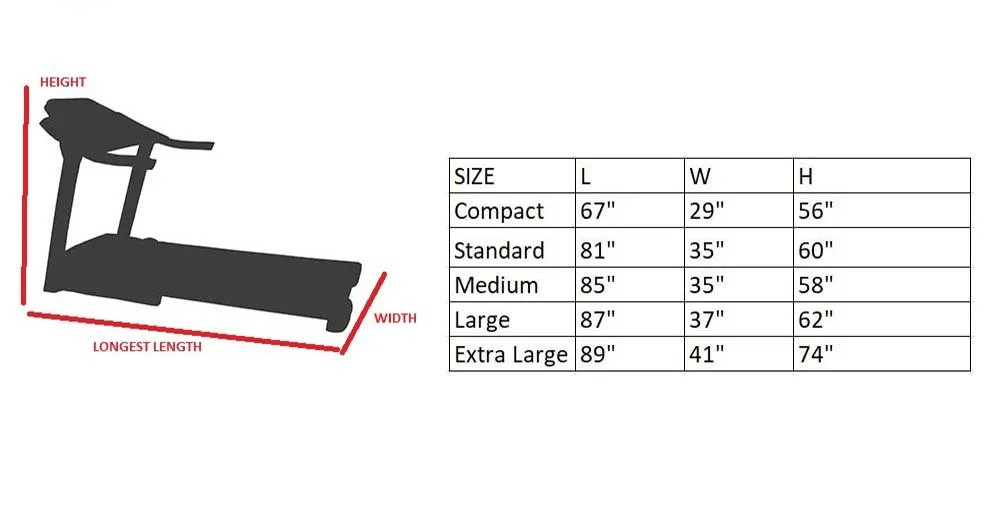
Start by measuring the treadmill's overall dimensions. You'll need its length, width, and height, but it's important to measure the machine at its widest, longest, and tallest points rather than relying on a single measurement for each dimension.
1. Measure the Overall Length
Measure from the frontmost point of the treadmill to the backmost point.
For most treadmills, this means measuring the full length of the base, including the motor housing and rear of the running deck. However, if the console or another component extends beyond the base, include that in your overall measurement.
Also record the length of the handrails or arms near the console if they extend beyond the main body of the treadmill.
2. Measure the Overall Width
Measure across the treadmill at its widest point, typically near the front of the machine.
Don't assume the front and back of the treadmill have the same width. Some models have a wider motor housing or console area, while others have a wider running deck.
For the most accurate information, record:
Width at the front of the treadmill.
Width across the running deck.
Width at the rear of the treadmill.
3. Measure the Height at the Front
Measure from the floor to the highest point of the console or display.
Include any protruding components that extend above the main console housing. This measurement establishes the overall height of the front section of the treadmill.
4. Measure the Height at the Back
Measure from the floor to the highest point at the rear of the treadmill.
The rear height will typically be much lower than the console height, but recording it helps establish the machine's overall shape and profile.
5. Record Additional Measurements
Length, width, and height provide a starting point, but additional measurements can help you better understand the shape of your treadmill.
Depending on the model, you may also want to record:
Console width and depth.
Handrail length and height.
Dimensions of the motor housing.
Any protruding knobs, handles, or other components.
These measurements can be especially helpful when comparing treadmills with different designs or configurations.
Common Measuring Mistakes to Avoid
A few small measurement errors can make it more difficult to determine the right cover size. Keep these points in mind:
Don't rely exclusively on manufacturer specifications. Published dimensions may be rounded or may not account for every protruding component.
Don't measure only the running deck. The console, motor housing, and handrails can extend beyond the base.
Don't assume the treadmill is symmetrical. The front, middle, and rear sections may have different widths and heights.
Don't forget attachments. Cup holders, accessory trays, and other built-in components may affect the overall dimensions.
Don't leave measurements unlabeled. Record exactly where each measurement was taken so there is no confusion when comparing dimensions.
How to Compare Your Measurements to Treadmill Cover Dimensions
Once you've measured your treadmill, the next step is comparing its dimensions against the covers available on our website.
Visit the product page for the treadmill cover you're considering and review its listed length, width, and height. Compare those dimensions with your treadmill measurements to get an idea of how well the cover will accommodate your equipment.
Keep a few things in mind when comparing measurements:
Allow for the overall shape of your treadmill. Two treadmills with similar overall dimensions may have different console shapes, handrail configurations, or motor housings.
Look at all three dimensions. A cover that is long enough may not be wide enough, and a cover with sufficient width may not provide enough height.
Consider the largest measurements. Make sure the cover can accommodate the widest and tallest portions of your treadmill.
Don't assume a close match is automatically a good fit. A few inches can make a difference depending on where the extra space is needed and how the cover is designed.
The goal is to find a cover that accommodates the full shape of your treadmill without being unnecessarily oversized.
Remember that the dimensions listed on our product pages describe the covers themselves, not the maximum treadmill dimensions they are guaranteed to accommodate. Comparing the two will help you determine which available option is most likely to work for your equipment.
Frequently Asked Questions
Can I use the dimensions listed on my treadmill manufacturer's website?
Manufacturer dimensions are a useful starting point, but they may not include all the measurements needed to determine cover sizing. Measuring the machine yourself can help clarify its exact dimensions and account for components that extend beyond the main frame.
Should I include the console when measuring my treadmill?
Yes. The console is often one of the tallest and widest parts of a treadmill. Include it when recording the machine's overall dimensions, along with any handrails or other components that extend beyond the base.
How much larger should a treadmill cover be than the treadmill?
There isn't one universal size allowance for every treadmill. The amount of additional room needed depends on the cover's design and the shape of the equipment. Compare all three dimensions rather than relying on length alone.
Can I use a cover that's slightly larger than my treadmill?
A slightly larger cover may work, but the amount of extra space and where it occurs both matter. A cover that's too large may not sit or drape as intended, while one that's too small may not fully cover the equipment.
How do I know if a standard treadmill cover will fit my machine?
Measure your treadmill's overall length, width, and height, then compare those measurements with the dimensions listed on the cover's product page. Consider the shape of your treadmill and any components that extend beyond its main frame when making your decision.
Can I use these instructions for a folding treadmill?
These instructions are intended for non-folding treadmills. Folding treadmills have additional considerations, including their folded dimensions and moving components. See our separate guide on how to measure a folding treadmill for a cover.
Find the Right Treadmill Cover
Taking a few minutes to measure your treadmill can make shopping for a cover much easier. By recording its length, width, and height and comparing those measurements against available cover sizes, you can narrow down your options and make a more informed purchasing decision.
Explore our selection of standard treadmill covers to find an option for your equipment. If you have questions about cover dimensions or need help understanding product sizing, contact Equip.